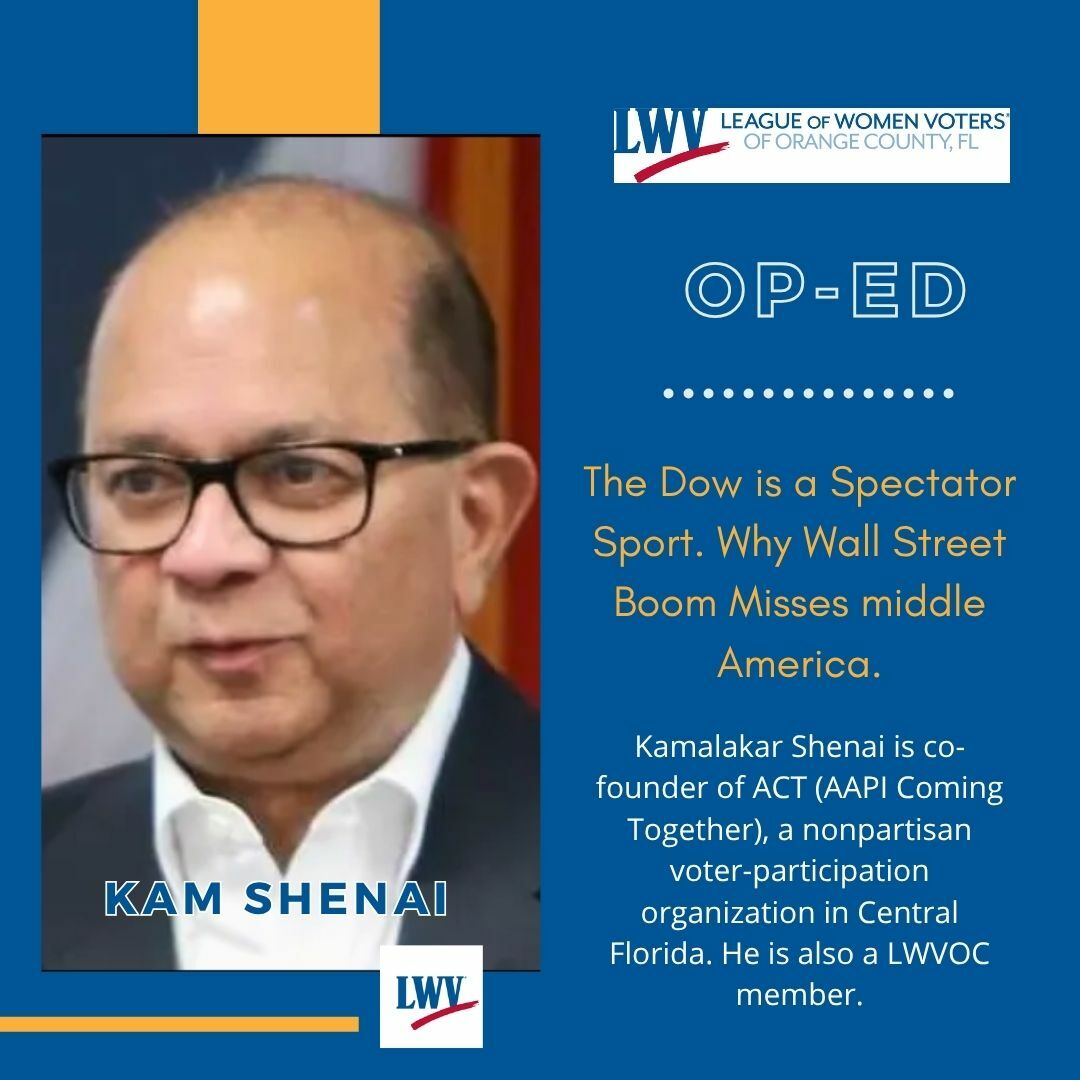
The Dow is a Spectator Sport: Why Wall Street Boom Misses middle America
By Kamalakar (Kam) Shenai
(Reposted from 6/22 Orlando Sentinel)
The other day, I was chatting with the technician who came to service my air conditioning. It was a typical, sweltering Central Florida afternoon, and as we stood in the heat, our conversation drifted from freon to the cost of living. He wasn’t thinking about corporate earnings or the Dow. He was thinking about the price of groceries, the rising cost of truck insurance, and how far his income would stretch by the end of the month.
I hear that same undercurrent of anxiety whenever I talk to my gardener, my handyman, local nurses, or the Uber drivers.
Yet the headlines can be euphoric: the Dow Jones Industrial Average has crossed 50,000. A milestone, we’re told. But when I talk to the hard-working people who keep our community running, not one of them has ever mentioned the 50,000 Dow. For tens of millions of American households, this record-breaking stock market is a spectator sport, a party they can see through the window but were never invited to join.
To understand this disconnect, we have to look at what a “50,000 market” actually means.
The Dow tracks 30 giant, publicly traded corporations. When it hits 50,000, it means investors are confident these corporations will keep making big profits. But it tells you nothing about whether my technician got a raise this year.
Headlines brag that 62% of Americans own stock. For most working people, that “ownership” sits locked inside a retirement account they cannot touch for decades. A market boom adds numbers to a screen. It doesn’t help them buy a tank of gas today.
We have split America into two different economic worlds: the asset economy and the wage economy. If you live in the asset economy, where wealth grows through stocks and investments, a booming market lifts you up. But look at the actual numbers: the wealthiest 10% of households own 93% of all stock market wealth. The top 1% alone owns more than half. The bottom 50% of Americans? They own just 1%.
One percent.
That single number makes every record-high headline ring hollow.
Nowhere is that gap clearer than right here in Florida. This year, a ConsumerAffairs study named Florida the worst state in the nation for renters. We now spend 37.4% of our income on rent, the highest share in the country. In Orange County, 61% of renters are cost-burdened, and after years of rents climbing far faster than paychecks, the math no longer works. The Dow hits record highs. My technician’s rent does too.
Let’s be clear about what this is not. America’s wealthy are not villains. They build companies that employ hundreds of thousands, and they give back generously; in all, Americans gave $592 billion to charity in 2024. That generosity is real. But charity is a choice. The real problem runs deeper. The workers who help build these companies own very little of them. That we can change.
For example, government can do two things. It can reward companies that share ownership with employees, the way Lakeland-based Publix, whose workers own roughly 80% of it, already does. And it can set up automatic retirement accounts for every worker, even those whose employers offer none, so the cashier and the AC technician build market wealth the same way shareholders do. These are not radical ideas. They are how you turn spectators into owners.
And the rest is up to us, the citizens. The next time someone points to a market record as proof the country is doing well, check if your own life feels that way too.
Until our economic report cards measure the financial security of the people who do the work, a booming stock market is just a number on a screen, one that means nothing to the man fixing your AC in the Florida heat.